bedra49260
Bismuth Brass
Characteristics:
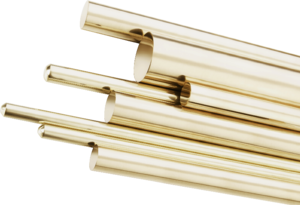
By replacing the lead element with bismuth, the material not only ensures excellent machinability but is also environmentally friendly. It possesses outstanding mechanical and electrical properties, making it an ideal substitute for leaded brass. The alloy is strictly lead-free according to RoHS.
Typical applications:
This alloy is widely used in TWS earphones, CMOS lens components, electronic products, hardware, connectors, valve cores, and food processing machinery.
Standardization and composition
| UNS | C49260 |
|---|---|
| EN | / |
| JIS | C6801 |
| GB | C49260 (HBi60-1-0.05) |
| Cu | 58.0-63.0 % |
| Pb | ≤ 0.009 % |
| Bi | 0.50-1.8 % |
| P | 0.05-0.15 % |
| Zn | Balance % |
Physical properties①
Note①:The testing temperature is 20℃. Note②:The testing temperature range is 20℃ to 300℃.
| Density (g/cm³) | 8.9 |
|---|---|
| Metling temperature (℃) | 884 |
| Electrical conductivity (%IACS) | 21.7 |
| Thermal conductivity (W / m x K) | 79 |
| Coefficient of thermal expansion② (10-6/K) | 17.5 |
| Modulus of elasticity (GPa) | 108.9 |
Fabrication Properties
Note③:C37700 = 100% Note④:C36000 = 100%
| Capacity for being cold worked | Fair |
| Capacity for being hot formed | Fair |
| Brazing | Good |
| Forgeability rating ③ | 70% |
| Machinability rating ④ | 80% |
Mechanical Properties⑤
Note⑤:bedra technical standard
| Temper | Diameter (mm) | Tensile Strength (MPa min.) | Yield Strength (MPa min.) | Elongation (A% min.) |
|---|---|---|---|---|
| H02 | 1.5≤Φ<25 | 420 | 170 | 7 |
| H02 | 25≤Φ<80 | 390 | 140 | 10 |
| H04 | 1.5≤Φ≤12 | 500 | 350 | 4 |
Dimension Tolerance and Delivery Forms
Note⑥:The tolerances listed in the table are specified as all plus or all minus. When tolerances are specified as plus and minus (±), half the values given.
| Straight bar | Coil wire | |||||
| Diameter (mm) | Tolerance⑥ (mm) | Ovality (mm max.) | Length (mm max.) | Straightness (mm/m max.) | ID (mm) | weight (kg) |
| 1.5≤Ф<3.0 | 0.02 | 0.010 | 2500 | 0.5 | 450 | 100 |
| 3.0≤Ф<6.0 | 0.02 | 0.010 | 3600 | 0.5 | 700 | 500 |
| 6.0≤Ф<10 | 0.03 | 0.015 | 3600 | 0.5 | 1200 | 800 |
| 10≤Ф<18 | 0.04 | 0.020 | 3600 | 0.5 | 1500 | 1000 |
| 18≤Ф<30 | 0.06 | 0.030 | 4000 | 0.5 | / | / |
| 30≤Ф<50 | 0.10 | 0.050 | 4000 | 0.5 | / | / |
| 50≤Ф<60 | 0.15 | 0.075 | 4000 | 0.5 | / | / |
| 60≤Ф≤80 | 0.30 | 0.150 | 3000 | 2.0 | / | / |
Other Delivery Forms
Tubes, Profiles
Further product information
Please contact us
Sales Asia-Pacific (Excluding-India)


Sales India



Sales North America







Berkenhoff GmbH (headquarters)
- Kinzenbach plant
- Berkenhoffstraße 14
- 35452 Heuchelheim
- Germany
- +49 641 601 0
- +49 641 601 222
- info(at)bedra.com
Berkenhoff GmbH
- Merkenbach plant
- Rehmühle 1
- 35745 Herborn
- Germany
- +49 2772 5002 0
- +49 2772 5002 155
- info(at)bedra.com
bedra Vietnam Alloy Material Co., Ltd
- Lot CN-06, Hoa Phu Industrial Park,
Mai Dinh Commune,
Hiep Hoa District, Bắc Ninh Province,
Vietnam
- +84 2043900104
- +84 2043900110
- info-asia(at)bedra.com
Close
Search

 English
  Deutsch
  Tiếng Việt